The University American College Skopje is proud to present the outstanding Capstone Projects developed by students in the School of Computer Science and Information Technology (SCSIT) for the 2025/2026 academic year.
Each project reflects the skills and experience our students have garnered throughout their studies, as well as their readiness to take on real-world challenges in computer science and information technology.
Congratulations to the students and their mentors on this achievement!
To view each project in detail, browse the showcases (8) below.
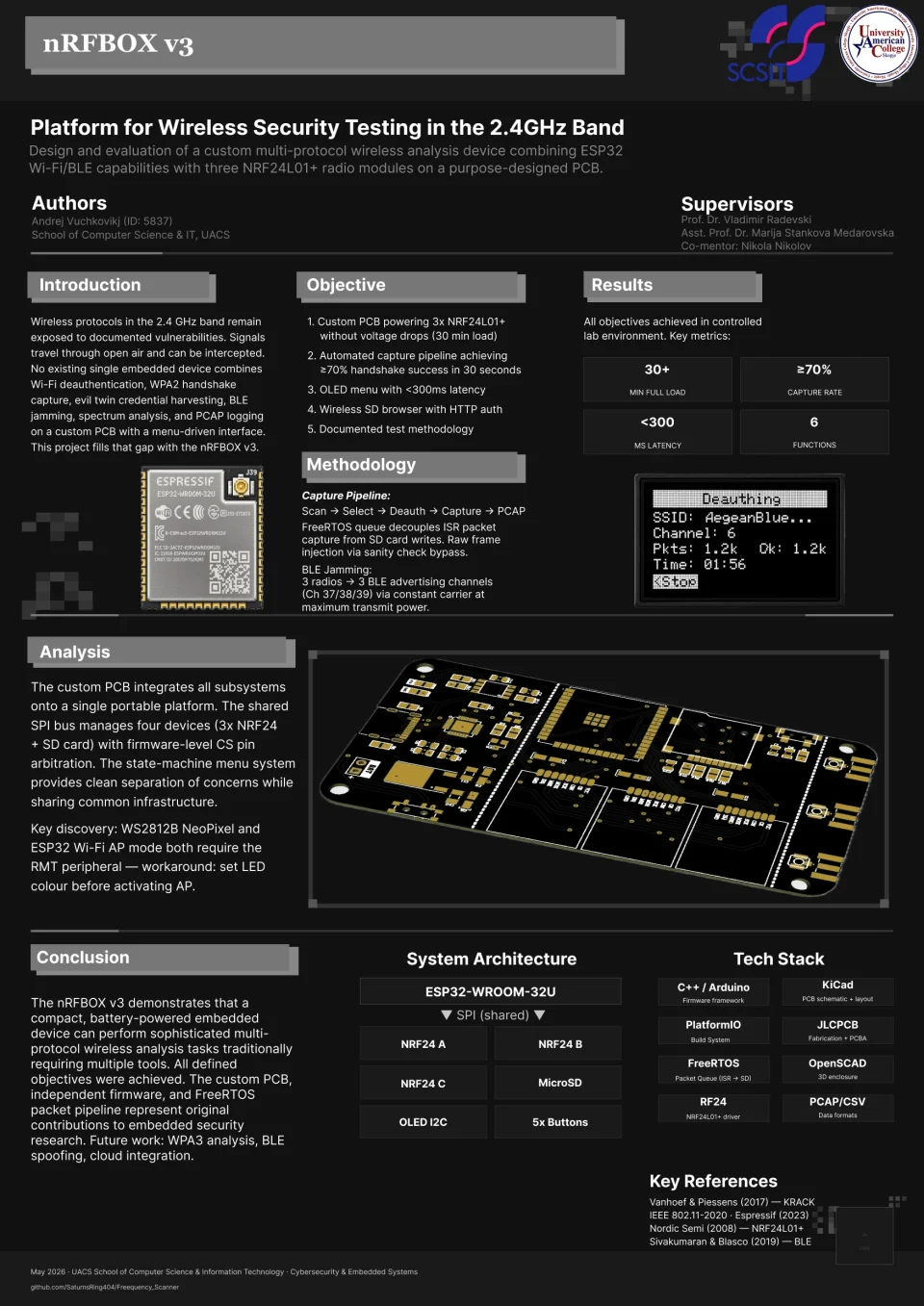
(I). nRFBOX v3 – Wireless Security Testing in Your Pocket
What if an entire wireless security toolkit could fit in your pocket?
Andrej Vuchkovikj developed nRFBOX v3, a compact, custom-built device that combines ESP32 technology with three radio modules to support wireless security analysis, including Wi-Fi handshake capture, BLE testing, and spectrum analysis.
A powerful example of how hardware engineering and cybersecurity come together in one portable solution.
Under mentorship of: Prof. Dr. Vladimir Radevski and Asst. Prof. Dr. Marija Stankova Medarovska
Industry collaborator: Nikola Nikolov, Senior Advisor at the Agency for Electronic Communications.
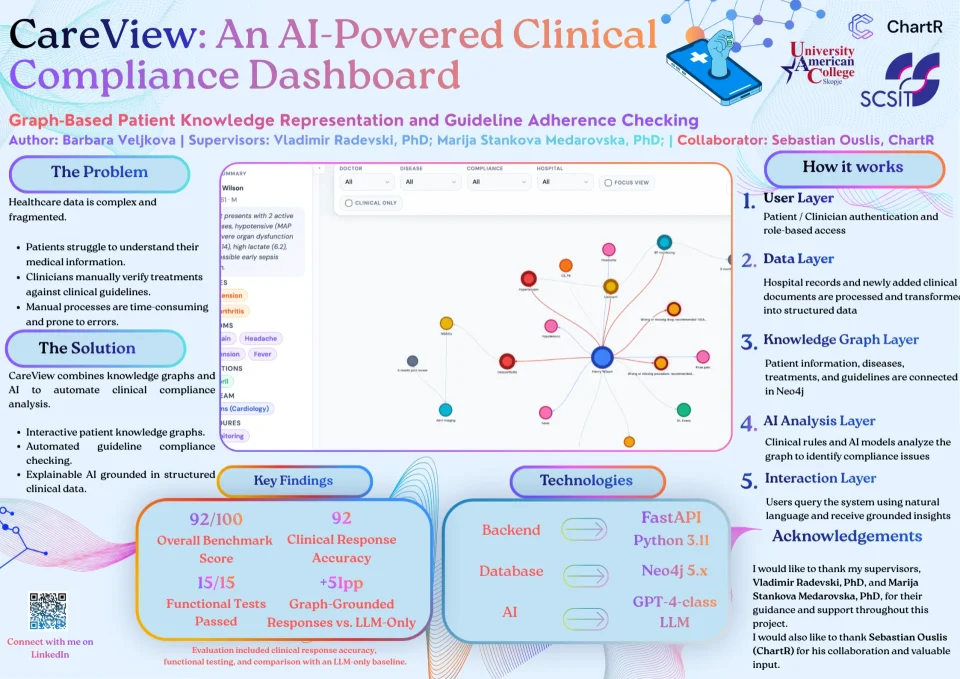
(II). CareView – Making Clinical Data Smarter with AI
Can artificial intelligence help clinicians make more informed decisions?
Barbara Veljkova developed CareView, an AI-powered dashboard that transforms fragmented medical records into interactive knowledge graphs, connecting patients, diagnoses, treatments, and clinical guidelines.
By automatically checking treatment compliance and providing understandable explanations, CareView explores how AI can support more transparent, informed healthcare decisions.
Under mentorship of: Prof. Dr. Vladimir Radevski and Asst. Prof. Dr. Marija Stankova Medarovska
Industry collaborator: Sebastian Ouslis, Co-founder of ChartR Health, New York City.
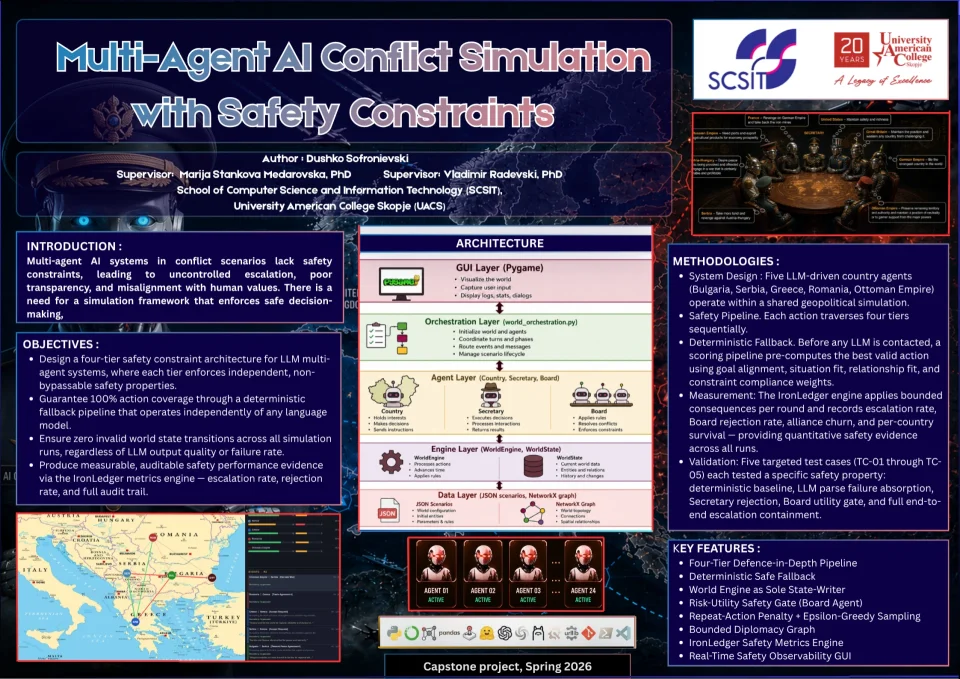
(III). Multi-Agent AI Conflict Simulation – Building AI with Safety in Mind
How do we ensure AI systems make responsible decisions in high-stakes situations?
Dushko Sofronievski developed a multi-agent simulation in which AI-powered agents navigate complex geopolitical scenarios while operating under strict safety constraints.
With a four-layer safety architecture, deterministic safeguards, and a complete audit trail, the project demonstrates how intelligent systems can be designed for accountability, transparency, and controlled decision-making.
Under mentorship of: Prof. Dr. Vladimir Radevski and Asst. Prof. Dr. Marija Stankova Medarovska
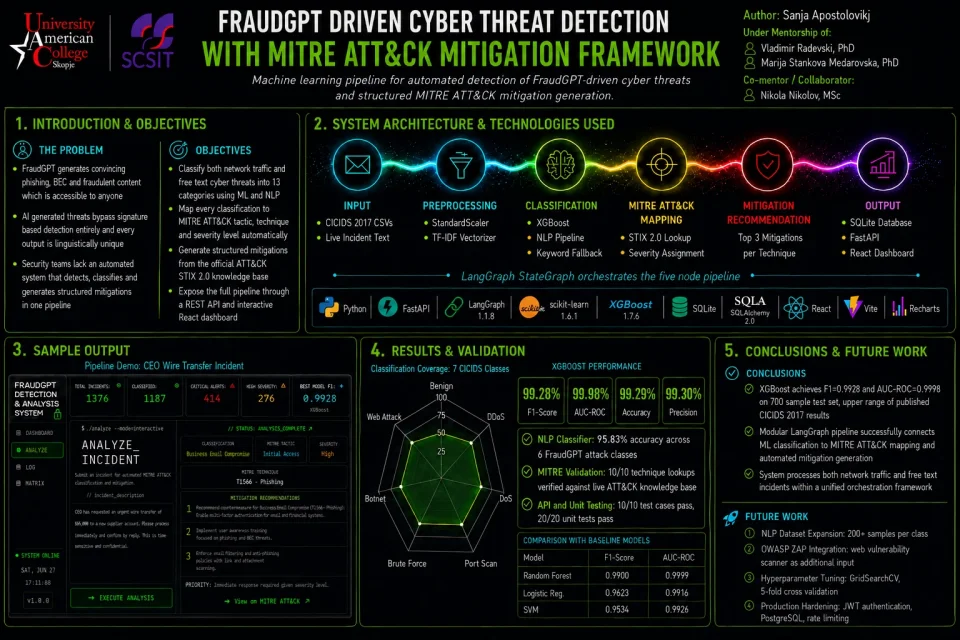
(IV).FraudGPT-Driven Cyber Threat Detection – Using AI to Defend Against AI
As AI-generated cyber threats become more sophisticated, cybersecurity needs smarter defenses.
Sanja Apostolovikj developed a machine-learning system that identifies AI-generated threats, classifies them, maps them to the MITRE ATT&CK framework, and recommends appropriate mitigation strategies.
By connecting threat detection directly with actionable security recommendations, the project demonstrates a practical approach to AI-powered cyber defense.
Under mentorship of: Prof. Dr. Vladimir Radevski and Asst. Prof. Dr. Marija Stankova Medarovska
Industry collaborator: Nikola Nikolov, MSc, Senior Advisor at the Agency for Electronic Communications.
(V). AI-Based Phishing Detection – Cybersecurity You Can Understand
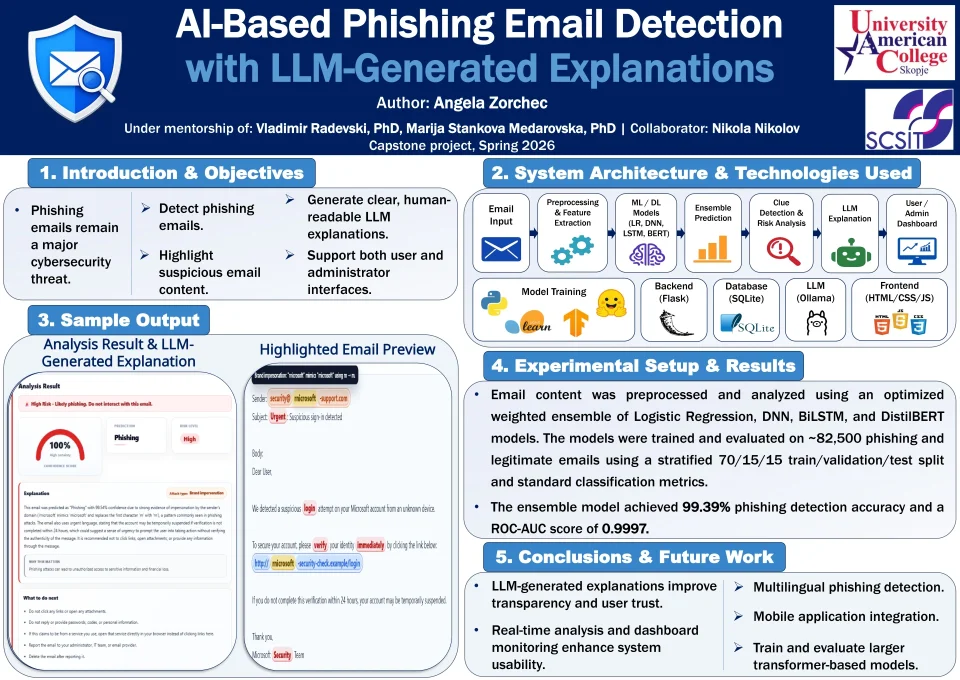
Detecting a phishing email is important. Understanding why it's dangerous is even better.
Angela Zorchec developed an AI-powered phishing detection system that combines multiple machine-learning models with LLM-generated explanations.
The system not only identifies suspicious emails with 99.39% accuracy but also highlights warning signs and explains potential threats in clear, accessible language.
Under mentorship of: Prof. Dr. Vladimir Radevski and Asst. Prof. Dr. Marija Stankova Medarovska
Industry collaborator: Nikola Nikolov, Senior Advisor at the Agency for Electronic Communications.
(VI). ParkingBuddy – Less Searching, Smarter Parking
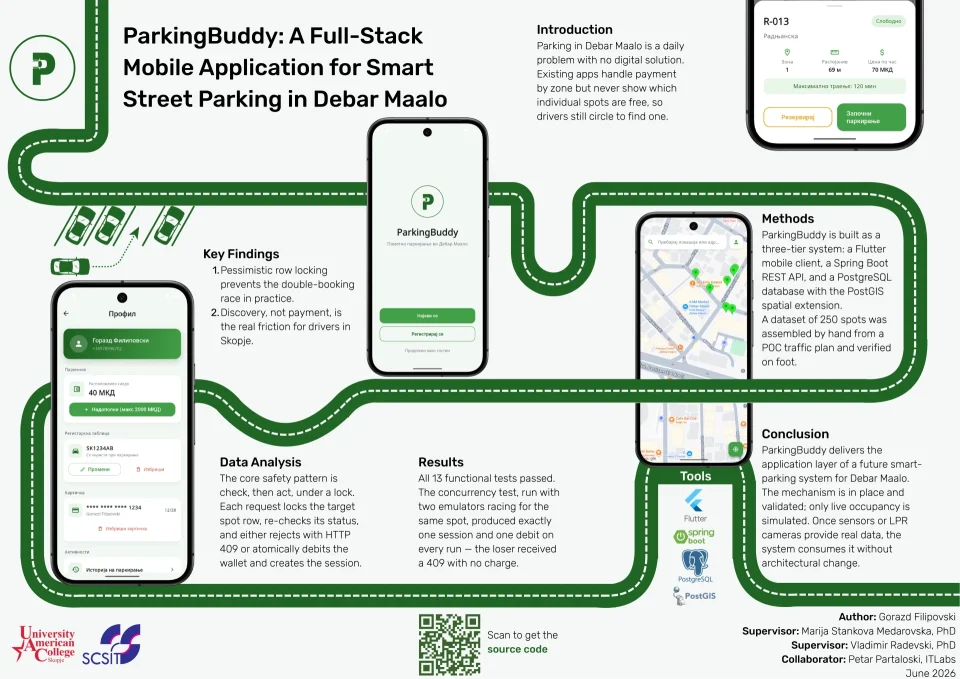
Finding a parking space in Skopje shouldn't mean driving around the same block repeatedly.
Gorazd Filipovski developed ParkingBuddy, a mobile application designed to help drivers discover available parking spaces in Debar Maalo.
Going beyond traditional parking payment apps, the platform introduces individual parking-space discovery and a booking mechanism designed to prevent double reservations. The prototype uses simulated occupancy data, laying the groundwork for future smart-city integration.
Under mentorship of: Prof. Dr. Vladimir Radevski and Asst. Prof. Dr. Marija Stankova Medarovska
Industry collaborator: Petar Partaloski, Software Engineer at IT Labs.
(VII). Smarter Ride-Sharing, Without Compromising Privacy
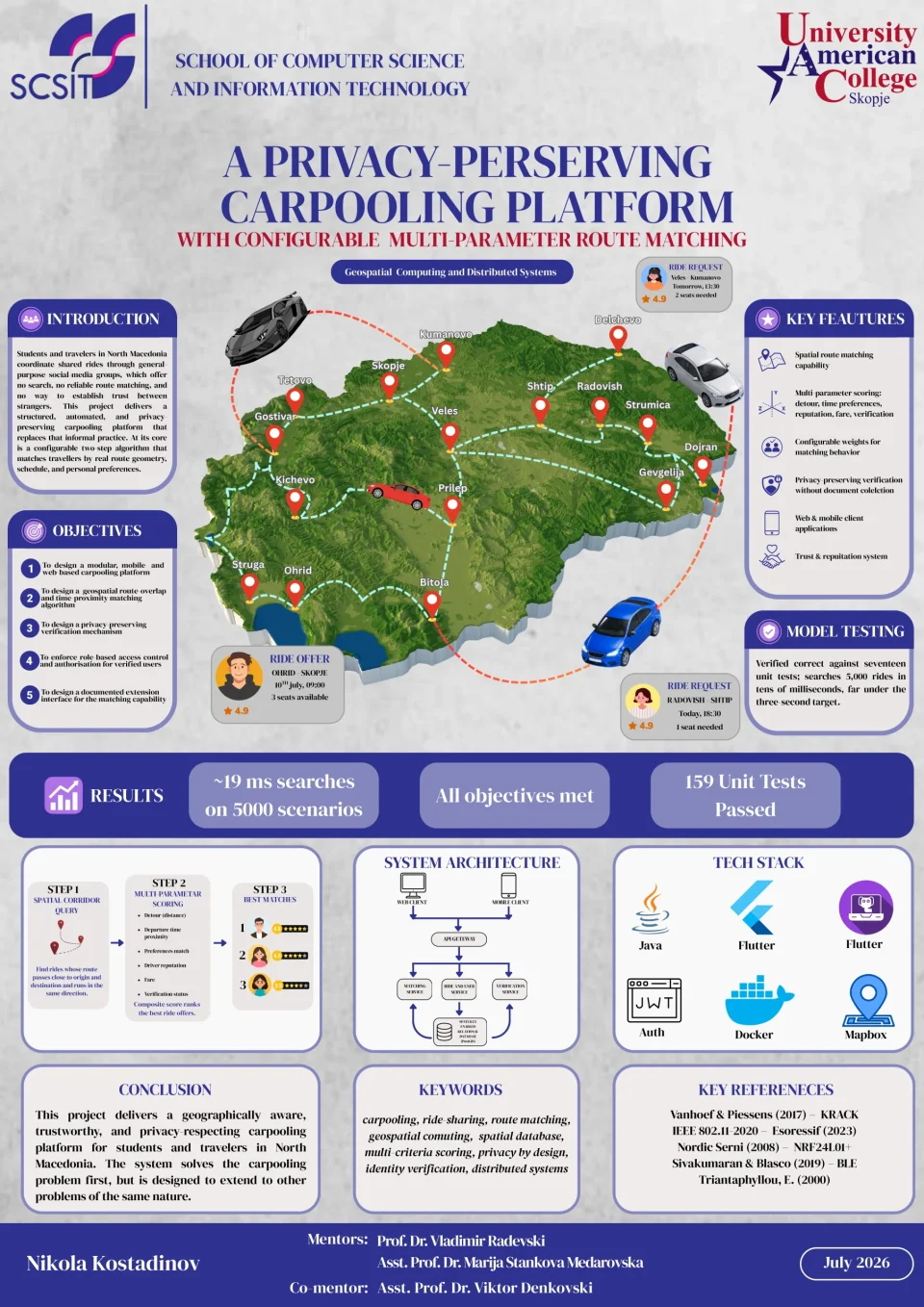
What if finding the right shared ride was faster, safer, and more reliable?
Nikola Kostadinov developed a privacy-preserving carpooling platform that intelligently matches travelers based on actual routes, departure times, and personal preferences.
Designed for students and travelers in North Macedonia, the platform combines intelligent route matching with trust-based verification that doesn't require collecting identity documents.
A practical example of technology making everyday travel more connected and convenient.
Under mentorship of: Prof. Dr. Vladimir Radevski and Asst. Prof. Dr. Marija Stankova Medarovska
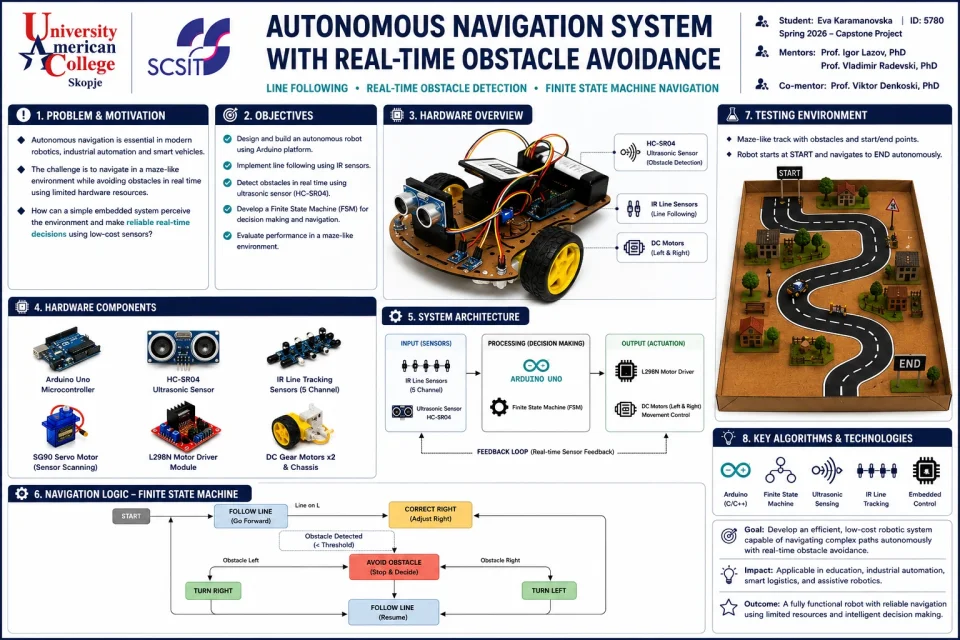
(VIII). Autonomous Navigation System with Real-Time Obstacle Avoidance
What if a small autonomous robot could navigate complex paths, follow designated routes, and detect obstacles in real time—all without human intervention?
Eva Karamonovska developed an autonomous robotic navigation system using an Arduino-based platform that combines line-following technology, ultrasonic obstacle detection, and intelligent decision-making.
Equipped with IR line-tracking sensors, an HC-SR04 ultrasonic sensor, and DC motors, the robot uses a Finite State Machine (FSM) to interpret sensor data, adjust its movement, and autonomously navigate a maze-like environment from start to finish while avoiding obstacles along the way.
A practical demonstration of how embedded systems, robotics, and real-time decision-making can bring autonomous navigation to life, with applications in industrial automation, smart logistics, education, and assistive robotics.
Under mentorship of: Prof. Igor Lazov, PhD and Prof. Vladimir Radevski, PhD
Co-mentor: Prof. Viktor Denkoski, PhD